Liam McArthur's speech to open debate on Assisted Dying bill
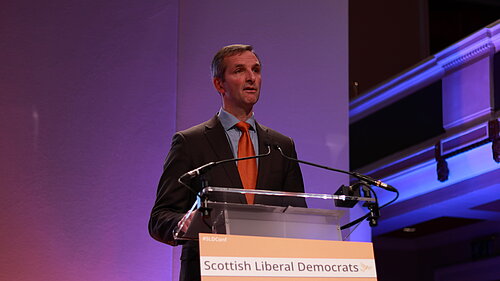
Liam McArthur MSP said:
"This is a significant moment for this parliament.
So let me start by acknowledging some of those who’ve played their part in getting us to this point.
NGBU who, like colleagues in the legislation team, are unsung heroes of this institution.
To my own team – Amanda, Niamh, Ashley and before them George, Peter and Jack, who’ve had my back throughout.
Dignity in Dying, FATE and Humanists Scotland who have run the most amazing campaign while also supporting me directly – and I remind the Chamber of my register of interests.
Those who responded to my original consultation in record numbers, many with the personal stories of dying Scots that I firmly believe must be at the front of our minds as we come to vote later.
The stakeholders who’ve engaged with me, while also supporting the scrutiny process with evidence to a Health Committee, which has carried out its responsibilities superbly.
And colleagues across this chamber who’ve given time to have conversations with me over the last five years and who, regardless of their position on the bill, engaged seriously and respectfully.
It’s often said parliament is at its best when it speaks with one voice. I believe it’s at it’s very best if it can come together when debating an issue upon which there is profound disagreement. I commend colleagues for rising to that challenge.
For me, this has been exemplified by the amending stages of this bill.
Of the 175 amendments agreed by parliament last week, half came from members who I expect to oppose the bill tonight.
This speaks to a determination amongst colleagues across the board to ensure that if this bill is passed it is the best it can be.
In drafting the Bill, I drew on international experience to ensure it was tightly drawn, heavily safeguarded and balanced the need for choice with the protection patients, medics and the public rightly expect.
Quite properly, at Health Committee and again last week, MSPs have had the chance to amend the bill to introduce further guardrails, additional clarity and stronger restrictions and requirements in a wide range of areas. That’s as it should be.
I may have introduced the bill, but it’s very much this parliament’s bill now.
It’s invidious to pick out individuals but let me throw caution to the wind. And these are colleagues who, at Stage 1, voted against or whose support was caveated.
Jackie Baillie has successfully introduced changes reflecting priorities of CHAS, the RCN & hospices.
Fulton MacGregor has been tenacious in speaking up for social work, securing changes that reflect the important role these professionals need to play in assessments and wider safeguarding.
Ruth Maguire helped parliament reinforce protections to address concerns around coercion.
Meanwhile, Bob Doris secured so many amendments at Stage 3, my office now refers to this as ‘Bob’s Bill’.
Together with Miles Briggs, however, they have ensured the needs of palliative care have been reflected in the debate around this bill – recognising the inevitable interaction between the two.
While this bill can’t address many of those issues, it’s allowed a light to be shone on a sector that is crucial but often misunderstood and undervalued.
Brian Whittle led the way on advance care plans and the importance of using this bill to promote much greater discussion and early planning of people’s wishes at the end of life.
Paul Sweeney ensured stronger requirements around signposting to social work and mental health services, an area he has commendably prioritised.
Daniel Johnson, whose forensic scrutiny of international legislation has been so impressive, lodged amendments that enabled debate on key issues, and put in place further safeguards including a prognosis period and mandating in-person meetings.
And finally, Ross Greer built in advocacy support for those who need it, while also – crucially – supporting my efforts to ensure fundamental protections and training for medical professionals will have to be in place before the provisions of this bill can be implemented.
On those issues of legislative competence, again I acknowledge the work of the Scottish and UK Governments.
They are neutral on the issue of assisted dying, but once this parliament voted strongly in favour of the general principles at Stage 1 last May, both governments worked at pace and in good faith.
In record time, they reached agreement on a way forward that respects both the will of this parliament and provisions of the Scotland Act.
That agreement allows issues around medicines and medical devices to be dealt with by a Section 30 order. No duty/no detriment protections as well as training, qualifications and experience requirements will be taken forward via a 104 order.
I recognise colleagues and some in the sector are anxious. But the fact remains, the provisions of this bill cannot come into force unless and until the 104 order is passed.
Of course, there are different views on the constitution and how the Scotland Act might look in future. We’ll have ample opportunity to debate those views in the run up to May’s election.
For now, the reality is that we must deal with the Scotland Act as it is, not as we would wish it to be.
At this point, I’d also like to pay personal tribute to the Cabinet Secretary.
Neil Gray is the MSP I’ve known longest. He’s a good friend and someone I respect enormously.
It’s not been easy for him to navigate the path he has on this bill, given the difference in views at Cabinet and across government. However, he’s discharged those responsibilities unwaveringly.
I hope he will now feel able to vote, like every other MSP, according to his conscience. To expect him to do otherwise would be unfair, unreasonable and unjust.
I said earlier that this is a significant moment for this parliament – probably the most significant.
I know too how conflicted many colleagues feel, some may even still be unsure how they will vote.
The responsibility perhaps weighs heavier today than at any point in this session.
Yet what we are doing is not breaking new ground or something legislators in states and countries around the world have not already done.
I accept that every assisted dying law is different and each must be tailored to meet the circumstances in that jurisdiction.
What I won’t accept, though, is the assertion that were this bill to be passed and the choice of assisted dying available in Scotland to those who meet the strict criteria, it would operate at odds with what we see in other states and countries with similar models based on terminal illness and mental capacity.
Dr Andrea Bendrups, President of VADANZ, the body for health professionals providing voluntary assisted dying care in Australia and New Zealand wrote to all MSPs last week. With many VADANZ members having trained or worked in the UK, our debate on this bill is being watched closely. In his letter, Dr Bendrups, writes,
“It’s been notable that the arguments are being made against a change in the law are in fact the same arguments that were made over many years in Australia and New Zealand.
“None of the fears raised have been realised in practice – eligibility criteria have not been expanded; proper assessments to confirm capacity and the absence of coercion have meant not all applicants are found eligible; and palliative care has flourished. Regular scrutiny and oversight show these laws are safe and are fulfilling their aims.”
Addressing concerns about doctor-patient relationships, Dr Bendrups goes on to say,
“As clinicians we know how helpless we can sometimes feel when palliative care has reached its limits and when our patients ask for help that we cannot offer.
“The change in the law on assisted dying meant we can now deliver a fuller range of choices to dying people in a more transparent and regulated manner. The integration of voluntary assisted dying into our existing health system has meant that end-of-life care is now safer and fairer than ever before.”
Presiding Officer, I don’t underestimate how difficult a decision this is for colleagues – even some very clear how they will vote and why.
We must recognise, however, that NOT passing this bill has consequences. The issue won’t go away, indeed numbers affected will only rise. All we do by putting off changing the law is push decisions overseas or behind closed doors.
So, as I did at Stage 1, I urge all MSPs to have the voices of dying Scots at the front of their minds when they come to vote.
To help with that, let me conclude with the words of Lisa, who visited parliament recently to share her experience of living with secondary breast cancer for the past nine years. Lisa explains:
“Sadly, choosing not to support this Bill is a vote for continuing the well-established risks and dangers present in the status quo. As with many things there is a cost of inaction. In this instance, the price of MSPs’ uncertainty would be mine to pay.”
“I attended a meeting with MSPs in Parliament last week where others with lived experience were in attendance and I heard again from those who have lost loved ones to my disease that the death I most fear cannot be avoided without this vital reform.
“Voting down this Bill is not risk free. The consequences are not hypothetical. They are lived every day.
“To the concern this would lead to an enormous change in healthcare, I disagree. I can already choose to refuse treatment whenever I wish, even if that treatment would save my life.
“I can legally choose to hasten my death by voluntarily stopping eating and drinking, literally starving myself to death.
“Doctors can already administer doses of morphine and other palliative medicines that would hasten my death as long as their motive is to alleviate my pain. Legalising assisted dying would not change my relationship to my doctor – it would allow me to be open and honest about what I want and ensure I wouldn't be forced to suffer against my wishes.
“I fight every day to live a little longer. But every day I have, contains fear over how I will die. If I knew I had the choice of an assisted death at the end, I could live the rest of my life without that fear.
“Please think of me as you cast your vote.”
Presiding Officer, I urge members to listen to Lisa and the many like her who desperately need us to give dying Scots more choice, dignity and compassion.