Cole-Hamilton challenges the First Minister over long A&E waits
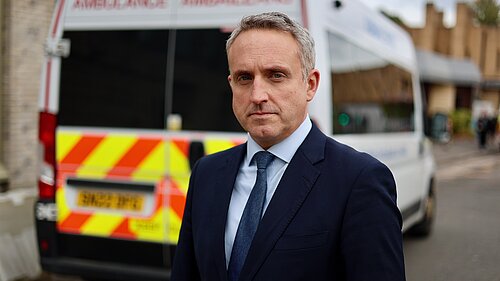
Scottish Liberal Democrat leader Alex Cole-Hamilton has today challenged the First Minister over long waits in A&E departments, raising the case of Isobel Knights and her long wait for care.
Alex Cole-Hamilton said:
“Isobel and Martyn Knights were travelling down the dual carriageway near Aberdeen when Isobel had a violent seizure and stopped breathing. With nowhere to pull over, Martyn had to use every ounce of his police training, getting her heart going again while the car was still moving, screeching to a halt at the front door of A&E, and explaining to staff everything that had happened.
“However, after moving their car, Martyn wasn’t allowed to return to Isobel’s side. A&E was just too busy. She was left alone in a corridor for six hours. Remember, her heart had only just been restarted. When she was eventually seen by a doctor, it was obvious that crucial information had been overlooked.
“So can I ask the First Minister, if you can turn up at A&E, having stopped breathing for minutes, and not be seen for hours, what does that say about the state of our NHS?”
He went on to say:
“Martyn and Isobel are absolutely clear: they’re not having a go at staff who looked exhausted that day in A&E.
“Emergency departments are backed up, because hospitals are rammed, because there are so many people stuck there, who should be in care homes or looked after at home. That’s what the Auditor General told us this morning.
“Let’s put this into perspective. When the SNP first came to power, in a single month, only a handful of people waited more than 12 hours at A&E. It hardly ever happened.
“Despite the best efforts of staff, that figure has increased by 63,000 per cent.
“So can I ask the First Minister, doesn’t Isobel and Martyn’s experience show how mistakes can be made, patients are put in danger, because A&E is overwhelmed on the SNP’s watch?”
Isobel Knights said:
“This has obviously been a tough time but I want to tell this story out of a genuine concern for our NHS and the unbelievable pressure that that staff are working under.
“The neurology consultant has been amazingly thorough and organised series of urgent tests and scans. My local GP practice has been amazingly supportive too, trying to be as proactive as they can be to help get to the root cause.
“I want it to be something that helps them by drawing attention to the huge pressure they are under on every shift.
“Everyone should be able to rely on first-rate health care, so they can get treatment when they need it. I’m concerned that staff and patients are not getting the support they need from SNP ministers.”
Martyn Knights said:
“Whilst we were driving south down the AWPR, Isobel started to have a violent seizure and suffered what was thought at the time to have been a minor stroke (or TIA). Fortunately, as we were approaching the Stonehaven roundabout junction I was able to start heading back to Aberdeen up the A92 to get her to ARI as quickly as possible!
“I had quickly ruled out stopping and calling 999 due to the potentially critical delays that an ambulance service under pressure may mean to any response!
“At this point I must give a shout out to my police driver training as unfortunately Isobel stopped breathing during the journey and as there was no immediate safe place to stop, I had to do chest strikes to try and get her going again. Doing this whilst ‘progressing my journey’ was a bit of a challenge I must admit!
“At one point I was getting very desperate for a lay-by or a road junction to appear as the chest strikes were not working and it was starting to become obvious that I needed to get her out of the car and onto her back to enable me to do proper CPR.
“I genuinely thought I had lost Isobel at this point, I gave her two more chest strikes and thank goodness it worked, the relief of that first raspy breath!
“On arriving at A&E, I stopped the car and ran to get medical staff to assist me. I quickly explained the circumstances including the fact that she stopped breathing and that I had to do chest compressions. Isobel at this point was slipping in and out of consciousness, however, at least she was able to communicate, which had not been the case since the seizure, although she was obviously disoriented.
“They wheeled her away in a wheelchair, telling me to return to reception to book Isobel in after moving my car as it was in a position that was partially obstructing the road.
“10 minutes later I was in back in the reception, I explained who I was and who I had brought in and they explained that I should go and wait in the waiting room and that someone would come and get me to take me through. At this point the two receptionists whispered to each other and there was a shake of the head, I was then told that A&E was very busy and it might take a little longer for someone to speak to me than usual. Fair enough I thought, we all know the pressures the NHS and A&E in particular are under, but that shake of the head, bearing in mind the circumstances, was a bit of a concern I must admit!
“After about 90 minutes I went back to speak to the receptionists and explained that as my wife had stopped breathing at one point and that it was obviously a serious situation could they at least tell me if she was still alive…I was surviving on the ‘no news is good news’ saying at this point. They assured me that everything appeared ok and she was in the ‘assessment corridor’ but that I could not join her until she had been moved to a cubicle.
“At the 2 hour point, one of the nurses that had come out to the vehicle walked past me, I quickly asked for any update and mentioned again that Isobel had stopped breathing. Again I was reassured that all was ok, but, that she was still in the assessment corridor.
“At the 3 1/2 hour point, the walkie-talkie function on my phone went off (thank you Apple Watch) it was Isobel, croaky, a bit confused, but alive and talking. She explained that she had had some bloods taken, but, no-one had asked her what had happened, which is fortunate, because she had no idea.
“At the 6 hour point I was told that Isobel had been moved to cubicle and I could join her.
“At the 7 hour point a doctor came into the cubicle, introduced himself and asked Isobel what happened. Isobel asked him to ask me as she didn’t have a clue.
“I explained the circumstances and got to the bit about Isobel stopping breathing and the fact that I had to do chest strikes to bring her back, it was at this point there was a look of surprise if not slight shock on his face, do you mean she was unconscious he said, I said no, I explained the condition Isobel was in and the signs, he quickly asked when was this, I said just over 7 hours ago now! He then asked how long was she not breathing for, I told him I could not be sure, but it felt like a good two to three minutes of driving if not more!
“It became quickly obvious that either this key bit of information was not in the notes or he had not had the time to read through them!
“This is where and how a system under severe pressure can lead to missed information or mistakes.
“Our NHS staff are brilliant, but the pressures they are under means that at times they are working with one hand tied behind their back.
“It was exceptionally busy that evening, I looked at the faces of the staff, they were 5 hours into their shift and they already looked exhausted.
“We need to look after this brilliant resource by providing them with the funding they desperately need to give them a fair chance to do their job.
“The good news is that Isobel is fine (as much as she can be), she remembers nothing, her body had shut down and protected her. She is now waiting for a stroke clinic appointment.
“As for myself, I am taking a bit of time to process the whole situation. It is far more difficult to do the actions I had to do when it is to someone you love.
“There were some critical decisions that had to be made and I am genuinely grateful that whatever training I have received in the past came through when I needed it!”